


Pandya Architecture:
The Pandya dynasty (c. 6th century B.C. – 16th century A.D.) had a long and complex history with multiple periods of rule. While not primarily known for their temple construction, they did make significant contributions to the development of gopurams. These massive entrance gateways  became a hallmark of South Indian temple architecture. The Pandyas expanded and embellished existing gopurams and built new ones during their later period (13th-16th centuries A.D.).
Although the earliest examples of gopurams appeared during the Chola period, the Pandyas played a crucial role in their further development. A typical gopuram consists of an oblong building that rises into a tapering tower, often exceeding 45 meters in height, with a rectangular entrance in the centre.
The Pandyas are also associated with the expansion and renovation of several important temples, including the Meenakshi Amman Temple in Madurai, which features numerous gopurams built and expanded over centuries.
The Pandya architecture had a lasting influence on South Indian temple architecture, particularly in Tamil Nadu. The grandiose scale, intricate carvings, and elaborate gopurams of Pandya temples set a high standard for subsequent architectural developments in the region. The emphasis on detailed ornamentation and complex temple layouts was carried forward by later dynasties, including the Vijayanagara and Nayaka dynasties.
Hoysala Architecture (1026-1343 A.D.):
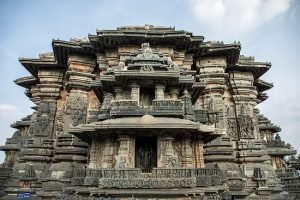
Hoysala Temples
Temples erected by the Hoysala kings have a distinctive style of architecture. Hoysala temples are known for their complex plans, which can be stellate (star-shaped), circular, or staggered square, with numerous angled projections. The carved surfaces are executed with remarkable precision, usually in soapstone (chloritic schist). The columns are lathe-turned, multi-faceted, or bell-shaped, often with intricate carvings. Each temple is supported by a low pyramidal tower (vimana), often surmounted by a vase-shaped ornament (kalasha).
On many occasions, multiple vimanas are used, making the temple look like a double or triple temple. Temples from the Hoysala period can be seen at Belur, Halebidu, and Somanathapura in Karnataka. The Chennakesava Temple, built by the Hoysala King Vishnuvardhana in 1117 CE, is the most celebrated of all the temples at Belur. The Hoysaleswara Temple is the most famous temple in Halebidu, renowned for its star-like plan and intricate carvings. It consists of two shrines dedicated to Lord Shiva, but they are not identical in design.